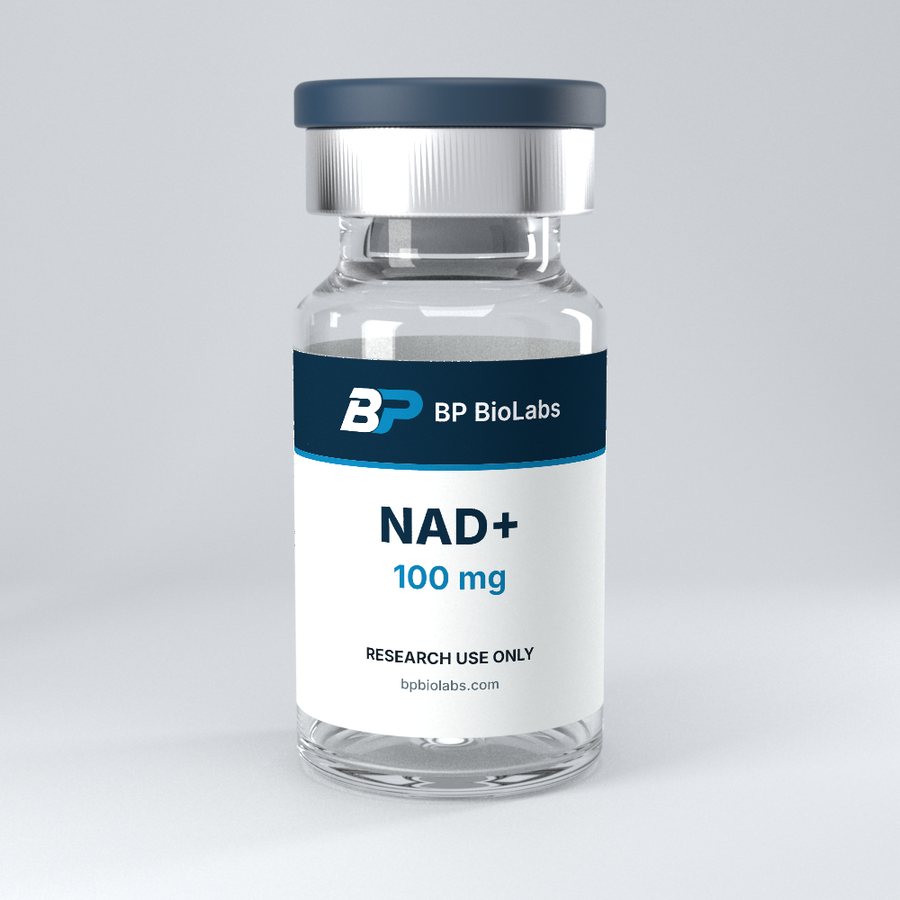
What NAD+ is
Nicotinamide adenine dinucleotide (NAD+) is a coenzyme for redox reactions, which makes it central to energy metabolism. It is also used up by enzymes that do not take part in redox reactions, including the sirtuins, CD38 and the poly(ADP-ribose) polymerases (PARPs), and through them it influences DNA repair, cell senescence and immune-cell function. [1]
NAD+ is a dinucleotide, not a peptide: two nucleotides joined through their phosphate groups. Cells build it from precursors such as nicotinamide riboside (NR) and nicotinamide mononucleotide (NMN), and NAD+ levels rise and fall with food intake, exercise and the time of day. [1] [4]
NAD+ and ageing
Tissue and cellular NAD+ levels decline gradually with age in several organisms, including rodents and humans, and that decline has been linked to age-related conditions such as metabolic disease, muscle loss and cognitive decline. [1] [4]
In skin samples from 49 people aged from newborn to 77, NAD+ levels fell with age in both men and women, while the activity of the DNA-repair enzyme PARP rose with age in men. In mice, the NAD-consuming enzyme CD38 increased with age and was required for the age-related fall in NAD+; CD38 was also the main enzyme breaking down the precursor NMN. [2] [3]
How raising NAD+ has been studied in people
Most human studies have given NAD+ precursors by mouth rather than NAD+ itself, because the precursors enter cells and are converted there. Restoring NAD+ improved health and extended lifespan in old or diseased animals, which is what prompted the human trials. [4]
The only study in the table that gave NAD+ itself was a small pilot that followed blood and urine during a six-hour infusion into a vein: plasma NAD+ and its breakdown products did not change for the first two hours, which the authors read as NAD+ being removed from the blood very quickly. [7]
| Study | Who took part | What was given | Main published finding |
|---|---|---|---|
| Martens et al., 2018 [5] | Healthy middle-aged and older adults | Nicotinamide riboside (NR), a precursor | Well tolerated; raised NAD+ metabolism in blood cells |
| Yoshino et al., 2021 [6] [8] | 25 postmenopausal women with prediabetes and overweight or obesity, 10 weeks, placebo-controlled | Nicotinamide mononucleotide (NMN), a precursor | Muscle insulin sensitivity and insulin signalling increased, with no change on placebo |
| Grant et al., 2019 [7] | Small pilot group | NAD+ itself, infused into a vein over six hours | No change in plasma NAD+ for two hours; NAD+ and methylnicotinamide appeared in urine |
Safety findings reported so far
The human studies so far have been small and short. Long-term supplementation with NR was well tolerated in healthy middle-aged and older adults. [5]
The pilot study of NAD+ given into a vein measured how the body handles it, not its effects or its safety over time. [7]
What is still unknown
Reviewers point out that much remains to be learnt: which mechanisms regulate NAD+ levels, how best to restore them in ageing, whether doing so is safe, and whether it brings benefits in ageing humans. [1]
Because CD38 breaks down both NAD+ and NMN and rises with age, part of the research now looks at blocking NAD+ consumption rather than only adding precursors. [3]
How to check a batch
NAD+ is usually supplied as a dry powder of the free acid or of a salt, and the form changes the measured mass and the amount of NAD+ per vial. A useful certificate of analysis names the testing laboratory, the batch number printed on the vial, the test date and the methods used, with identity by mass spectrometry and purity by HPLC.
Where the manufacturer supplies a batch report, we link it on the product page; products without one do not claim one.
Perguntas frequentes
Is NAD+ a peptide?
No. It is a dinucleotide, a coenzyme found in every cell. It is sold alongside peptides because it is used in the same kind of laboratory research. [1]
What is the difference between NAD+, NR and NMN?
NR and NMN are precursors that cells convert into NAD+. Most human trials have used these precursors by mouth rather than NAD+ itself. [1] [5] [6]
Do NAD+ levels really fall with age?
Yes, in several organisms, including rodents and humans; in human skin, NAD+ levels fell with age in both men and women. [1] [2]
Can I buy NAD+ for personal use?
No. Everything we sell is for in vitro laboratory research by adults aged 21 or over. It is not for use in people or animals, and we give no advice on use or dosing.
Este guia resume pesquisas publicadas e informações regulatórias. Não é aconselhamento médico. Tudo o que vendemos é somente para pesquisa de laboratório in vitro, por adultos de 21 anos ou mais, e não para uso em pessoas ou animais.
Fontes
- Covarrubias AJ et al. NAD+ metabolism and its roles in cellular processes during ageing. Nat Rev Mol Cell Biol. 2021 (PubMed 33353981)
- Massudi H et al. Age-associated changes in oxidative stress and NAD+ metabolism in human tissue. PLoS One. 2012 (PubMed 22848760)
- Camacho-Pereira J et al. CD38 Dictates Age-Related NAD Decline and Mitochondrial Dysfunction through an SIRT3-Dependent Mechanism. Cell Metab. 2016 (PubMed 27304511)
- Rajman L et al. Therapeutic Potential of NAD-Boosting Molecules: The In Vivo Evidence. Cell Metab. 2018 (PubMed 29514064)
- Martens CR et al. Chronic nicotinamide riboside supplementation is well-tolerated and elevates NAD+ in healthy middle-aged and older adults. Nat Commun. 2018 (PubMed 29599478)
- Yoshino M et al. Nicotinamide mononucleotide increases muscle insulin sensitivity in prediabetic women. Science. 2021 (PubMed 33888596)
- Grant R et al. A Pilot Study Investigating Changes in the Human Plasma and Urine NAD+ Metabolome During a 6 Hour Intravenous Infusion of NAD+. Front Aging Neurosci. 2019 (PubMed 31572171)
- ClinicalTrials.gov NCT03151239: Effect of Nicotinamide Mononucleotide (NMN) on Cardiometabolic Function