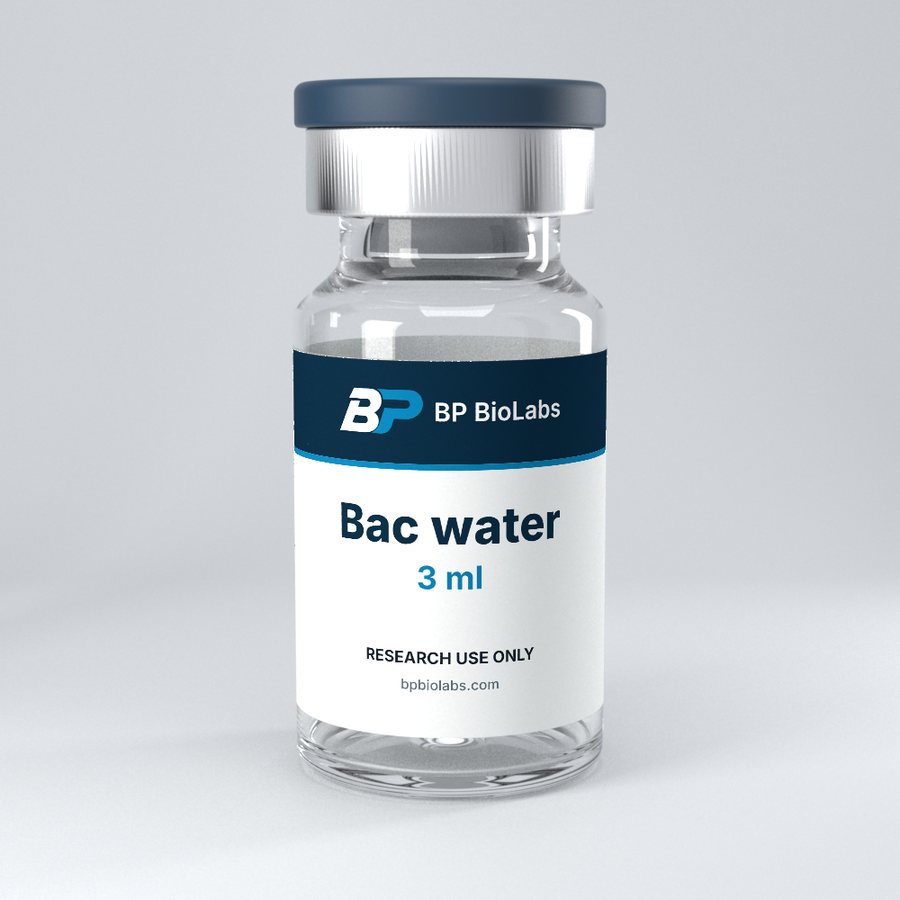
Two waters, one difference
Sterile water is purified water that has been sterilised and contains nothing else: no preservative and no salt. Once the container is opened, nothing in it holds back microbes that get in, which is why preservative-free water is meant for a single use and multi-use containers rely on a preservative. [1]
Bacteriostatic water is sterile water with a preservative added, benzyl alcohol, usually at 0.9%. The same preservative at the same strength is used in bacteriostatic saline, and 0.9% benzyl alcohol in water is the solution used in formulation studies of multi-use protein products. [2] [5]
What “bacteriostatic” means
Bacteriostatic means that the solution holds back the growth of bacteria; it does not mean that it sterilises. Preservatives are added to multi-use containers to destroy or inhibit microbes that may be introduced each time the container is opened. [1] [6]
A preservative is not a guarantee. In a laboratory study of multi-use vials preserved with benzyl alcohol, Serratia marcescens carried in through a wet, contaminated stopper survived in the solution for up to three days in the cold. Clean technique matters with either water. [3]
Where benzyl alcohol is a problem
Benzyl alcohol is an active chemical, not an inert ingredient. In 1982 it was identified as the cause of the “gasping syndrome”, a fatal poisoning of premature newborns exposed to solutions preserved with it. [4]
For in vitro laboratory research the point is simpler: a preservative is one more substance in the experiment, and it can interact with the molecule being studied, as the next section shows. [1]
Preservatives and peptides
Some preservatives make proteins and peptides more likely to form particles, so formulators choose a preservative that is compatible with the molecule, not only one that keeps microbes out. [1]
The effect depends on the molecule and on the preservative. With a recombinant protein, dissolving the freeze-dried powder in 0.9% benzyl alcohol caused more aggregation than plain water. With an acylated peptide of 31 amino acids, benzyl alcohol caused no detectable aggregation, while another common preservative, m-cresol, produced insoluble aggregates. [5] [6]
Perguntas frequentes
Is bacteriostatic water sterile?
Yes, while sealed: it is sterile water with a preservative added. After opening, the preservative limits the growth of microbes that get in; it does not sterilise, and contamination can still survive in it. [1] [3]
What is the preservative in bacteriostatic water?
Benzyl alcohol, usually at 0.9%, the same as in bacteriostatic saline. [2] [5]
Why is sterile water meant for a single use?
Because it contains no preservative: once it is opened, nothing stops microbes that enter from growing. Multi-use containers rely on a preservative for that. [1]
Does benzyl alcohol affect peptides?
It depends on the molecule. It increased the aggregation of one recombinant protein and had no detectable effect on one acylated peptide; other preservatives, such as m-cresol, can behave differently. [5] [6]
Este guia resume pesquisas publicadas e informações regulatórias. Não é aconselhamento médico. Tudo o que vendemos é somente para pesquisa de laboratório in vitro, por adultos de 21 anos ou mais, e não para uso em pessoas ou animais.
Fontes
- Stroppel L et al. Antimicrobial Preservatives for Protein and Peptide Formulations: An Overview. Pharmaceutics. 2023 (PubMed 36839885)
- Hunt SV, Malhotra R. Bacteriostatic preserved saline for pain-free periocular injections: review. Eye (Lond). 2022 (PubMed 35017698)
- Marumo K et al. Experimental confirmation of Serratia marcescens contamination in multiple-dose vials of heparin-saline solution. J Infect Chemother. 2004 (PubMed 16163464)
- Gershanik J et al. The gasping syndrome and benzyl alcohol poisoning. N Engl J Med. 1982 (PubMed 7133084)
- Roy S et al. Effects of benzyl alcohol on aggregation of recombinant human interleukin-1-receptor antagonist in reconstituted lyophilized formulations. J Pharm Sci. 2005 (PubMed 15614819)
- Li M et al. Molecular Mechanism of Antimicrobial Excipient-Induced Aggregation in Parenteral Formulations of Peptide Therapeutics. Mol Pharm. 2022 (PubMed 35917158)