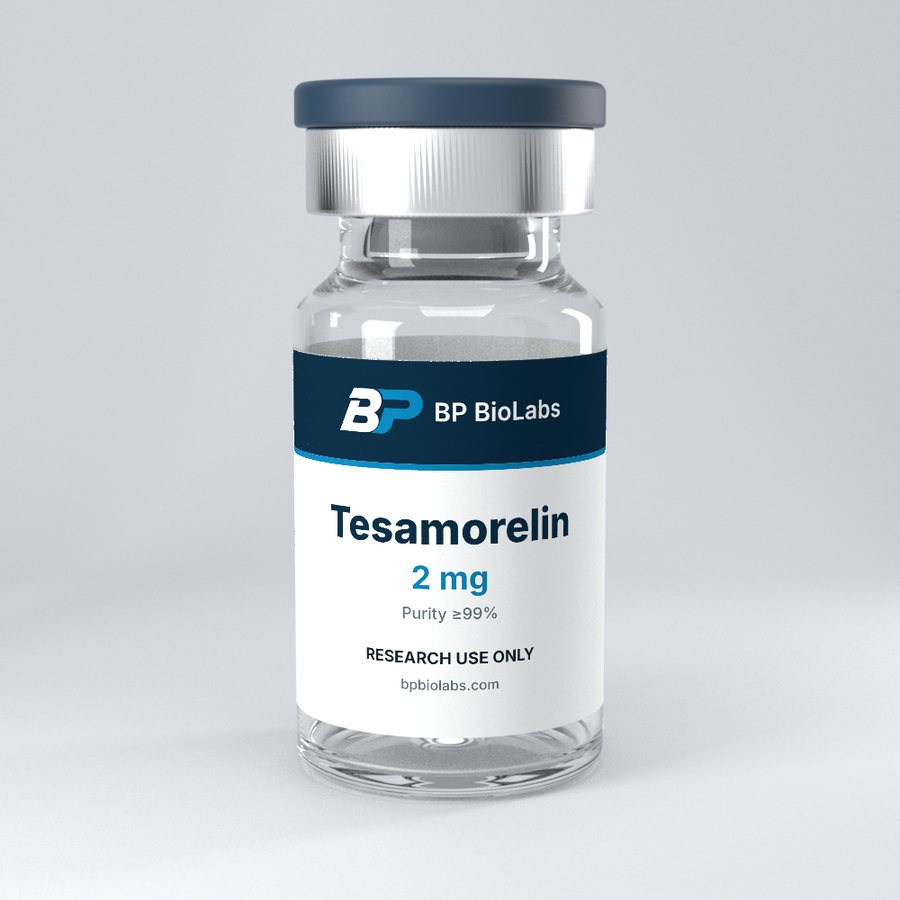
What tesamorelin is
Tesamorelin is a synthetic peptide of 44 amino acids with the sequence of human growth hormone-releasing hormone (GHRH), the hormone from the hypothalamus that signals the pituitary gland to release growth hormone. The only change is a trans-3-hexenoyl group added to the first amino acid of the chain. [1]
That change makes it resistant to dipeptidyl peptidase-4, the enzyme that quickly inactivates natural GHRH: in the laboratory it broke down more slowly in plasma, and in animals it stayed in the blood longer. Because it acts upstream, it raises the body's own growth hormone and, in turn, insulin-like growth factor 1 (IGF-1). [1] [2]
How it has been studied
The main trials were two phase 3 studies in adults with HIV on antiretroviral therapy who had accumulated fat inside the abdomen (visceral fat). Each compared tesamorelin with placebo for 26 weeks and continued with a 26-week extension; visceral fat was measured by computed tomography. [2] [3] [4]
Later trials in the United States looked at liver fat in people with HIV, and others at memory and thinking in older adults. A 2026 meta-analysis of four randomised trials with 909 participants with HIV found reductions in visceral fat, waist circumference and trunk fat, and an increase in lean body mass. [5] [6] [7] [8] [9]
| Trial | Who took part | Length | Main published result |
|---|---|---|---|
| Phase 3, first trial (2007) | 412 adults with HIV and excess abdominal fat | 26 weeks | Visceral fat −15.2% with tesamorelin against +5.0% with placebo; triglycerides and the total to HDL cholesterol ratio also fell [2] |
| Phase 3, both trials pooled (2010) | 806 adults with HIV and excess abdominal fat | 26 weeks, then a 26-week extension | Treatment effect on visceral fat −15.4% against placebo at week 26, maintained to week 52 in those who continued [4] |
| Liver fat, one centre (2014) | 50 adults with HIV and abdominal fat accumulation | 6 months | Visceral fat and liver fat fell against placebo, with a net effect of −2.9 points on the liver fat measure [5] |
| Fatty liver disease, two centres (2019) | 61 adults with HIV and fatty liver disease | 12 months | Liver fat fraction −4.1 points against placebo, a 37% relative reduction; 35% against 4% ended below the 5% threshold [6] |
| Cognition in older adults (2012) | 152 adults aged 55 to 87, 66 of them with mild cognitive impairment | 20 weeks | Favourable effect on a combined cognitive score, mainly executive function, similar in both groups [7] |
| Cognition in people with HIV (2025) | 73 adults with HIV, abdominal obesity and cognitive impairment | 6 months | Waist circumference fell more than with standard care, but the cognitive change did not differ between groups [8] |
Safety findings reported so far
In the first phase 3 trial, adverse events overall did not differ significantly between tesamorelin and placebo, but more participants on tesamorelin withdrew because of one; glucose measures did not change significantly. In the extension, adverse events were as frequent as in the first 26 weeks. [2] [3]
A review of the phase 3 programme reports serious adverse events in under 4% of participants over 26 weeks; the most frequent events were reactions at the site of administration and effects known from growth hormone, such as joint pain, headache and swelling of the limbs. In the cognition trial in older adults, mild adverse events were reported by 68% on tesamorelin and 36% on placebo. [10] [7]
Visceral fat came back when tesamorelin was stopped, so the effect lasted only during treatment. The 2026 meta-analysis noted growth hormone-related adverse effects, more people stopping treatment than with placebo and limited long-term safety data. [3] [9]
Regulatory status (November 2026)
In the United States the FDA approved tesamorelin in November 2010 for one use: reducing excess abdominal fat in adults with HIV who have lipodystrophy. It has no approval for other uses, such as weight loss in general or liver disease. [11]
Research material is not a medicine: it has not been reviewed for safety, effectiveness or quality in people and must not be used in people. We sell tesamorelin only for in vitro laboratory research, without instructions for use.
Anti-doping status
Tesamorelin is on the World Anti-Doping Agency's Prohibited List: it is named among the analogues of growth hormone-releasing hormone in class S2, prohibited at all times, in and out of competition, together with CJC-1295 and sermorelin. [12]
Its detection window is short. In a 2026 study in six volunteers, intact tesamorelin could not be found in urine; in serum its breakdown products were found for up to two hours, so the authors recommend that tests look for those products in serum. [13]
What is being studied now
Two phase 2 trials were recruiting on ClinicalTrials.gov in November 2026. One compares tesamorelin with placebo for 52 weeks in 120 adults with fatty liver disease linked to metabolic dysfunction, measuring liver fat by MRI; it is the first of the recent trials outside HIV. The other, TRIUMPH, tests tesamorelin with a home exercise programme in 100 adults aged 50 to 80 with HIV, looking at physical function and muscle. [14] [15]
Storage and stability in the lab
Peptides can degrade through chemical routes such as oxidation, deamidation and hydrolysis and through physical routes such as aggregation, and they are generally more stable in the dry state than in solution. Tesamorelin contains a methionine, an amino acid that oxidises easily: oxidised forms were found in the 2026 anti-doping study. [16] [13]
Lyophilised vials are therefore normally kept cold, dry and away from light until they are used. The storage statement on the product page and on the batch certificate takes precedence.
How to check a batch
A useful certificate of analysis names the testing laboratory, the batch number printed on the vial, the test date and the methods used. Identity is usually confirmed by mass spectrometry, where the measured mass should match the expected molecular mass, and purity is measured by HPLC.
Where the manufacturer supplies a batch report, we link it on the product page; products without one do not claim one.
Common questions
What does TH9507 mean?
It is the development code of tesamorelin, used in the laboratory studies and the first clinical trials. The pooled analysis of the phase 3 trials uses both names. [1] [4]
Is tesamorelin approved?
In the United States, yes, since November 2010, but only to reduce excess abdominal fat in adults with HIV who have lipodystrophy. It has no approval for other uses. [11]
How is tesamorelin different from ipamorelin and CJC-1295?
Tesamorelin and CJC-1295 are classed as analogues of growth hormone-releasing hormone; ipamorelin belongs to another group, the growth hormone secretagogues. All three are on the World Anti-Doping Agency's Prohibited List. [12]
What did the phase 3 trials show?
In the pooled analysis, visceral fat fell with tesamorelin against placebo, with a treatment effect of 15.4% at week 26, and triglycerides fell too, while fat under the skin of the abdomen did not change significantly. The reduction was maintained to week 52 in those who continued and was lost after stopping. [3] [4]
Can I buy tesamorelin for personal use?
No. Everything we sell is for in vitro laboratory research by adults aged 21 or over. It is not for use in people or animals, and we give no advice on use or dosing.
This guide summarises published research and regulatory information. It is not medical advice. Everything we sell is for in vitro laboratory research only, by adults 21+, and not for use in people or animals.
Sources
- Ferdinandi ES et al. Non-clinical pharmacology and safety evaluation of TH9507, a human growth hormone-releasing factor analogue. Basic Clin Pharmacol Toxicol. 2007 (PubMed 17214611)
- Falutz J et al. Metabolic effects of a growth hormone-releasing factor in patients with HIV. N Engl J Med. 2007 (PubMed 18057338)
- Falutz J et al. Long-term safety and effects of tesamorelin, a growth hormone-releasing factor analogue, in HIV patients with abdominal fat accumulation. AIDS. 2008 (PubMed 18690162)
- Falutz J et al. Effects of tesamorelin (TH9507), a growth hormone-releasing factor analog, in human immunodeficiency virus-infected patients with excess abdominal fat: a pooled analysis of two multicenter, double-blind placebo-controlled phase 3 trials with safety extension data. J Clin Endocrinol Metab. 2010 (PubMed 20554713)
- Stanley TL et al. Effect of tesamorelin on visceral fat and liver fat in HIV-infected patients with abdominal fat accumulation: a randomized clinical trial. JAMA. 2014 (PubMed 25038357)
- Stanley TL et al. Effects of tesamorelin on non-alcoholic fatty liver disease in HIV: a randomised, double-blind, multicentre trial. Lancet HIV. 2019 (PubMed 31611038)
- Baker LD et al. Effects of growth hormone-releasing hormone on cognitive function in adults with mild cognitive impairment and healthy older adults: results of a controlled trial. Arch Neurol. 2012 (PubMed 22869065)
- Ellis RJ et al. Effects of tesamorelin on neurocognitive impairment in persons with HIV and abdominal obesity. J Infect Dis. 2025 (PubMed 39813152)
- Ditta AM et al. Efficacy and safety of tesamorelin in people living with HIV (PLWH) with lipodystrophy: a systematic review and meta-analysis. J Int Assoc Provid AIDS Care. 2026 (PubMed 42538058)
- Dhillon S. Tesamorelin: a review of its use in the management of HIV-associated lipodystrophy. Drugs. 2011 (PubMed 21668043)
- Spooner LM, Olin JL. Tesamorelin: a growth hormone-releasing factor analogue for HIV-associated lipodystrophy. Ann Pharmacother. 2012 (PubMed 22298602)
- World Anti-Doping Agency. International Standard: Prohibited List 2026 (in effect from 1 January 2026)
- Colpaert T et al. Detecting GHRH analogue tesamorelin and its metabolites in post-administration human urine and serum using LC-HRMS/MS. Drug Test Anal. 2026 (PubMed 43013893)
- ClinicalTrials.gov NCT07481734: A randomized, double-blind, placebo-controlled phase II study of tesamorelin for reducing hepatic steatosis in adults with metabolic associated steatotic liver disease
- ClinicalTrials.gov NCT06554717: Tesamorelin as an adjunct to exercise for improving physical function in HIV (TRIUMPH)
- Manning MC et al. Stability of protein pharmaceuticals: an update. Pharm Res. 2010 (PubMed 20143256)