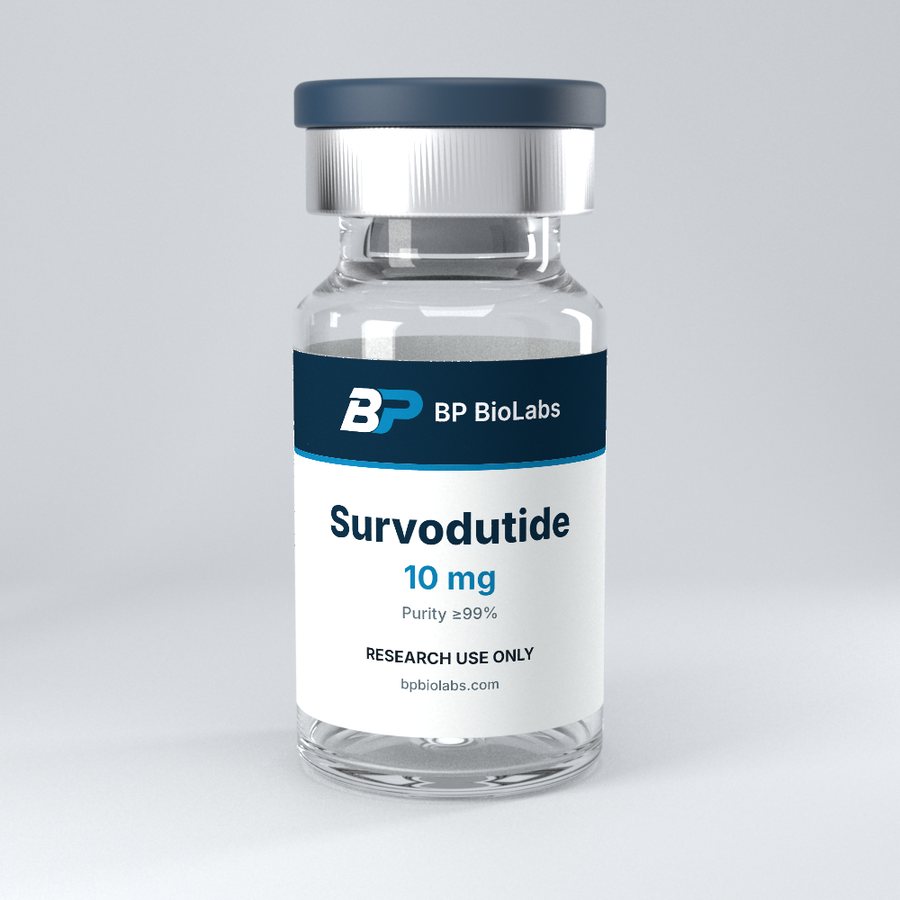
What survodutide is
Survodutide is a peptide that activates two receptors, those of glucagon and of GLP-1. It follows the model of oxyntomodulin, a gut peptide that activates both receptors and in people lowers body weight by raising energy expenditure and reducing food intake. [1]
It carries a fatty-acid chain that extends its half-life. In mice it lowered body weight more than semaglutide, a GLP-1 receptor agonist. Boehringer Ingelheim develops it under licence from Zealand Pharma. [1] [5]
How it has been studied
Boehringer Ingelheim first ran phase 2 trials in obesity and in MASH, a fatty liver disease with inflammation, then the SYNCHRONIZE phase 3 programme. The trials in the table were randomised and placebo-controlled. [2] [3] [4] [5] [6]
The phase 3 reports give two kinds of figures: one that counts every participant, including those who stopped treatment early, and one that assumes treatment went on as planned. The table uses the first. In SYNCHRONIZE-MASLD, for example, body weight fell by 8.7% against 1.4% with placebo counting every participant, and by 12.2% against 1.0% assuming full treatment. [4] [5]
| Trial | Who took part | Length | Main published result |
|---|---|---|---|
| Phase 2, obesity (2024) | 386 adults with overweight or obesity, without diabetes | 46 weeks | Mean body-weight change of -6.2% to -14.9% across doses, against -2.8% with placebo [2] |
| Phase 2, MASH (2024) | 293 adults with MASH and liver fibrosis | 48 weeks | MASH improved without worsening of fibrosis in 43% to 62% of participants across doses, against 14% with placebo [3] |
| Phase 3 SYNCHRONIZE-1 (2026) | 725 adults with obesity, without diabetes | 76 weeks | Mean body-weight change of -12.2% and -13.0% with the two doses, against -5.4% with placebo [4] |
| Phase 3 SYNCHRONIZE-MASLD (2026) | 216 adults with obesity and at-risk fatty liver disease | 48 weeks | Liver fat fell by at least 30% in 68.5% of participants, against 28.6% with placebo [5] |
| Phase 3 SYNCHRONIZE-CVOT (2026) | 5,507 adults with obesity at increased cardiovascular risk | Median 22 months | Major cardiovascular events in 3.7% of participants, against 4.1% with placebo [6] |
Safety findings reported so far
The most frequent adverse events were gastrointestinal, mostly mild to moderate and common while the dose was being increased. In SYNCHRONIZE-1 they affected 80.9% and 89.7% of participants on the two doses, against 47.9% on placebo; no deaths were reported. [4] [5]
In SYNCHRONIZE-CVOT, gastrointestinal adverse events led about one participant in five on survodutide to stop treatment, against 1.9% on placebo, while serious adverse events occurred at similar rates in all groups. The trial showed no increase in the risk of major cardiovascular events. [6]
Regulatory status (November 2026)
Survodutide is not an approved medicine: the phase 3 reports published in 2026 describe it as an investigational drug, and the results of the cardiovascular safety trial were published in November 2026. [4] [6]
Research material is not a medicine: it has not been reviewed for safety, effectiveness or quality in people and must not be used in people. We sell survodutide only for in vitro laboratory research, without instructions for use.
What is being studied now
Phase 3 trials registered on ClinicalTrials.gov include LIVERAGE, in people with MASH and moderate or advanced fibrosis, a trial on blood sugar control in type 2 diabetes, SYNCHRONIZE-HERA in women during or after menopause, and ELEVATE-LIVER on heart structure and function in people with fatty liver disease. [7] [8] [9] [10]
Storage and stability in the lab
Peptides can degrade through chemical routes such as oxidation, deamidation and hydrolysis and through physical routes such as aggregation, and they are generally more stable in the dry state than in solution. [12]
Lyophilised vials are therefore normally kept cold, dry and away from light until they are used. The storage statement on the product page and on the batch certificate takes precedence.
How to check a batch
A useful certificate of analysis names the testing laboratory, the batch number printed on the vial, the test date and the methods used. Identity is usually confirmed by mass spectrometry, where the measured mass should match the expected molecular mass, and purity is measured by HPLC. Because survodutide carries a fatty-acid chain, the expected mass includes it. [1]
Where the manufacturer supplies a batch report, we link it on the product page; products without one do not claim one.
Veelgestelde vragen
What does the code BI 456906 mean?
It is the development code under which Boehringer Ingelheim first described survodutide; the early papers use it. [1]
Is survodutide approved?
No. As of November 2026 it is investigational, and phase 3 trials have reported results in obesity, fatty liver disease and cardiovascular safety. [4] [5] [6]
Why is survodutide studied in liver disease?
Activating the glucagon receptor as well as the GLP-1 receptor may work better in MASH than activating the GLP-1 receptor alone. A phase 2 trial supported this, and the LIVERAGE phase 3 trial is under way. [3] [7]
How is survodutide different from mazdutide?
Both activate the glucagon and the GLP-1 receptor, but they are different molecules from different developers. Mazdutide, from Eli Lilly and Innovent Biologics, has been approved in China since 2025; survodutide is still investigational. [4] [11]
Can I buy survodutide for personal use?
No. Everything we sell is for in vitro laboratory research by adults aged 21 or over. It is not for use in people or animals, and we give no advice on use or dosing.
Deze gids vat gepubliceerd onderzoek en informatie van toezichthouders samen. Het is geen medisch advies. Alles wat we verkopen is alleen voor in-vitro-laboratoriumonderzoek, door volwassenen van 21+, en niet voor gebruik bij mensen of dieren.
Bronnen
- Zimmermann T et al. BI 456906: discovery and preclinical pharmacology of a novel GCGR/GLP-1R dual agonist with robust anti-obesity efficacy. Mol Metab. 2022 (PubMed 36356832)
- le Roux CW et al. Glucagon and GLP-1 receptor dual agonist survodutide for obesity: a randomised, double-blind, placebo-controlled, dose-finding phase 2 trial. Lancet Diabetes Endocrinol. 2024 (PubMed 38330987)
- Sanyal AJ et al. A phase 2 randomized trial of survodutide in MASH and fibrosis. N Engl J Med. 2024 (PubMed 38847460)
- le Roux CW et al. Survodutide once weekly for the treatment of adults with obesity (SYNCHRONIZE-1). N Engl J Med. 2026 (PubMed 42253238)
- Kaplan LM et al. Survodutide in adults with obesity and metabolic dysfunction-associated steatotic liver disease: SYNCHRONIZE-MASLD, a randomized, double-blind, placebo-controlled phase 3 trial. Nat Med. 2026 (PubMed 42252333)
- Bozkurt B et al. Cardiovascular outcomes with survodutide in adults with obesity at increased cardiovascular risk (SYNCHRONIZE-CVOT): a double-blind, randomised, placebo-controlled, phase 3 trial. Lancet. 2026 (PubMed 43003106)
- ClinicalTrials.gov NCT06632444: LIVERAGE, a study to test whether survodutide helps people with NASH/MASH who have moderate or advanced liver fibrosis (phase 3)
- ClinicalTrials.gov NCT07754461: A study to test whether survodutide helps people with type 2 diabetes control their blood sugar (phase 3)
- ClinicalTrials.gov NCT07850050: SYNCHRONIZE-HERA, in women living with overweight or obesity who are going through or have finished menopause (phase 3)
- ClinicalTrials.gov NCT07850063: ELEVATE-LIVER, on heart structure and function in people with overweight or obesity and fatty liver disease (phase 3)
- Shirley M. Mazdutide: First Approval. Drugs. 2025 (PubMed 41028652)
- Manning MC et al. Stability of protein pharmaceuticals: an update. Pharm Res. 2010 (PubMed 20143256)